
How to move objects
The object moves by the difference in position between frames. By adding frames and moving objects, an animation can be created. The objects that can be animated are as follows
- Player Objects
- Ball Object
- Marker Object
- Line objects
- Oval and rectangle objects
- Polygon and polyline objects
Text and handwriting objects cannot be animated.
Properties that can be changed by animation
The properties that can be changed by animation are as follows
- Player object, ball object, marker object
- Position
- Rotation
- Player object (switched per frame)
- Visibility
- 3D pose, view angle display and angle
- Name display
- Line object
- Position
- 3D height of each point
- Rectangle/oval object
- Position
- Rotation
- Size
- Polygon/polyline object
- Vertex position
None of the objects can animate opacity or color.
A player's pose, view angle, and name display are normally recorded on the current frame only. While a range of frames is selected, they are applied to every frame in the range.
Curving player and ball movements
Player and ball objects can move along curves. Player and ball objects can display the trajectory from the previous frame and the trajectory to the next frame by turning on the display of paths. Paths are drawn in the player's color, which makes it easier to tell several players' movements apart. 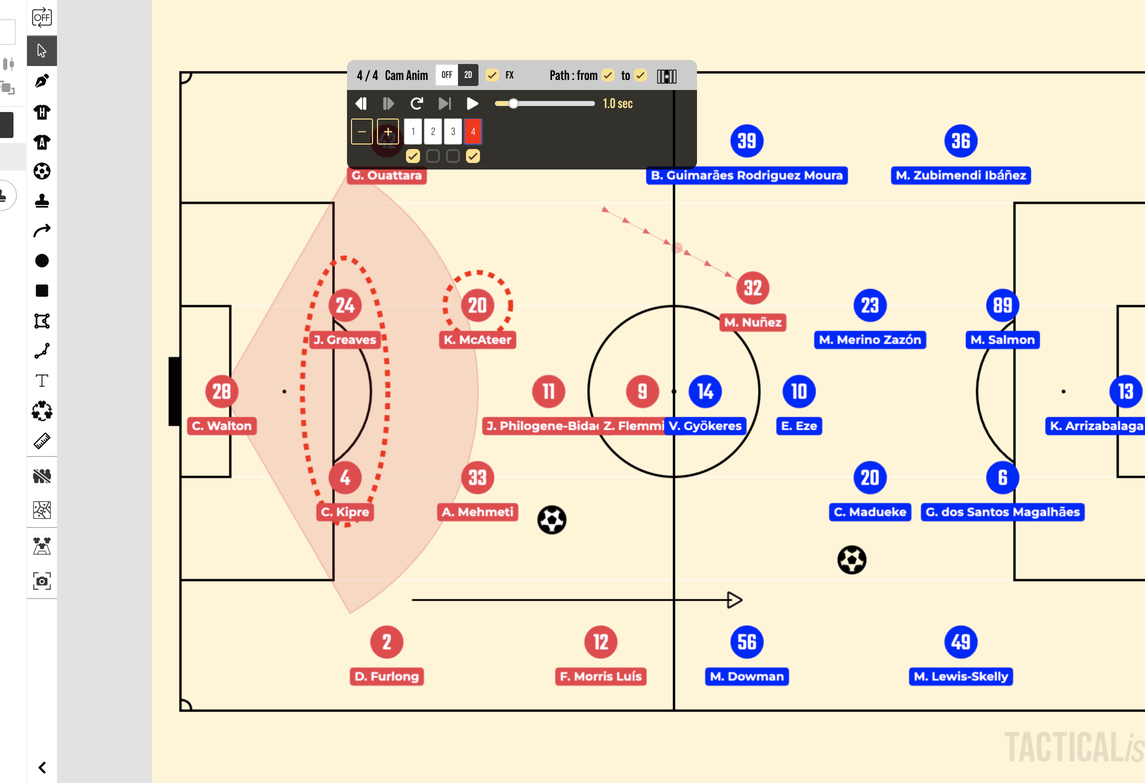
Curving with the anchor point
With path display on, an anchor point (a faint circle) appears midway along a movement path. Drag the anchor point to curve the movement.
Adding path vertices
When you select one player or ball, "Add" and "Remove" appear in the bottom row of the animation controller ( / in the header do the same). "Add" adds a vertex to the movement path, and dragging the vertices lets you create S-curves and other complex movements.
- The first time you press "Add" on a straight path, two vertices are created that divide the path into thirds. Until you bend the path, each press spaces the vertices evenly again.
- After the path is bent, "Add" keeps the other vertices in place and adds a vertex between the last vertex and the destination.
- "Remove" deletes vertices one at a time, starting from the one closest to the destination. When no vertices are left, the movement is straight again.
- A path can have up to 10 vertices.
- Not available for paths traced on the field, and not shown on frame 1.
- Playback in 2D and 3D and exported videos all follow the same curve.
Facing the direction of travel
Select one player and turn on "Auto-orient" on the controller, and while the player moves in that frame, the body turns to follow the direction of the path (in the header, switch it with ; it shows when on).
- The player turns smoothly from the previous frame's direction at the start, and into the destination direction on arrival.
- Turning it on sets the destination direction to the direction at the end of the path. If you then rotate the player by hand, that direction is kept.
- Turning it off returns an automatically set destination direction to the previous frame's direction (a direction you set by hand is kept).
- Only players can use it (not the ball). For paths traced on the field, it is on from the start.
- Playback in the 3D view follows the same directions as in 2D.
Tracing a movement on the field
To move an object along a line you draw freely, select the object, press "Motion path" on the controller ( in the header), and trace on the field. Where you finish tracing becomes the object's position in that frame.
- "Motion path" is shown when the selected object has not moved yet in that frame. It is not shown on frame 1.
Resetting a movement
To set a movement again, select the object and press "Reset" on the controller ( in the header). The movement and path vertices in that frame are removed, and the object returns to its position in the previous frame.
Ball height (3D)
When a ball with a movement is selected, "3D Height" sliders appear in the ball settings panel. Set a height from 0 to 15m for the start, mid, and end points of the movement, and the ball flies in an arc during playback in the 3D view. The movement on the 2D board does not change. → 3D Ball, Markers & Shapes